
Posted By Sam Smith on Jan 12, 2026


Five years ago, Georgia Tech transitioned from a contract-managed model to a self-operation dining program. With a massive operation serving 7,000 to 8,000 meals a day in dining halls alone, the Institute needed a way to manage tight margins and rising food costs.
Under the guidance of the Senior Dining Leadership Team, Georgia Tech utilized Leanpath not just as a food waste tracking and prevention solution, but as a comprehensive training and operational tool. By leveraging data and photography, the team uncovered critical inefficiencies in inventory management, culinary skills, and production forecasting, leading to a more profitable and sustainable operation.
The Challenge: The Shift to Self-Op
When Georgia Tech moved its dining services in-house, they gained control but also assumed full responsibility for the bottom line. With a $53 million top-line revenue, even small inefficiencies could result in significant financial losses.
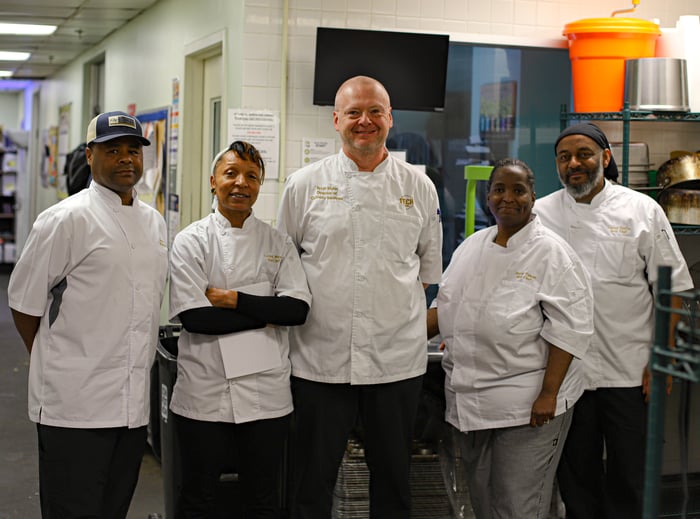
As new managers and staff joined the team, Houston Freeman, Director of Residential Dining at the time, and Scott Bruhn, Director of Culinary, noticed inconsistencies. Food costs were creeping up in specific dining halls, driven by preventable behaviors that were uncovered by Leanpath data:
- Premature Disposal: Reusable items like rice and meats were being discarded at the end of shifts.
- Overproduction: Large batches of vegetables were cooked too close to closing time, resulting in "dead" product that could not be saved.
- Skill Gaps: Veteran staff members lacked standardized knife skills, leading to excessive trim waste on high-value items.
The Solution: Data-Driven Culture Change
Georgia Tech implemented Leanpath to gain visibility into what was being thrown away and why. However, the technology was only half the solution; culture was the other half.
Freeman recognized that staff initially viewed food waste tracking with suspicion, fearing it was a disciplinary tool. To combat this, leadership reframed Leanpath as a mechanism for professional development and operational excellence. With the help of Danielle Ismirele-Dunigan, Director of Safety and Training, they incentivized participation with "SWAT teams" for problem-solving and small rewards (like candy bars) for consistent tracking, shifting the mindset from fear to engagement.
"It's really about building that trust in the team to say, look, this is really just a tool for us to get better," explains Freeman.
Georgia Tech has also implemented Leanpath AI tracking technology, which uses machine vision to automatically identify food waste, making the process faster and more accurate.
“AI has made our tracking so much more accurate and has increased usage with our staff,” explained Bruhn “It simplifies the weighing process as well as gives us more accurate results in the report.”
Key Strategies and Operational Wins
Through the insights provided by Leanpath, Georgia Tech implemented specific changes that reduced waste and improved food quality.
1. Standardizing Knife Skills
Data revealed high trim waste on produce and proteins. Even experienced cooks were losing excessive product due to inefficient cutting techniques.
- The Action: The culinary team standardized cutting processes for difficult items like watermelons and onions.
- The Result: Creating flat bases for round vegetables prevented slipping and "lost trim," increasing yield.
2. Staff-Led Innovation (The Salmon Story)
The data sparked conversations that empowered staff to share their own expertise. When management introduced a knife technique for skinning salmon to reduce waste, a staff member suggested a better alternative: using their hand to separate the skin from the meat without a knife.
- The Outcome: This method was faster, safer, and resulted in a cleaner yield than using a knife, proving that waste reduction fosters employee engagement.
3. Repurposing for Authenticity (The Rice Story)
Managers were throwing away pans of leftover rice, viewing it as waste. Bruhn and Freeman worked with the chefs and used this as a teaching moment regarding culinary authenticity and efficiency.
- The Insight: Authentic fried rice is best made with day-old rice.
- The Benefit: By saving the rice for the next day's menu, the team reduced food waste, lowered labor and utility costs (by not cooking a fresh batch), and produced a higher-quality, authentic dish for students.
4. Correcting Inventory Flow (FIFO)
Leanpath data highlighted instances where whole cases of expensive proteins (e.g., beef) or chicken were spoilage waste.
- The Find: This wasn't a cooking error, but a stocking error. Clerks were placing new inventory in front of old stock, violating the First-In, First-Out (FIFO) principle.
- The Fix: Retraining receiving staff on proper stocking procedures to ensure older product is used first.
The Results
Implementing a rigorous food waste prevention strategy has delivered benefits across three pillars: Financial, Social, and Experiential.
- Financial Visibility: The department can now correlate spikes in food cost directly to waste events, allowing for immediate corrective action in weekly finance meetings.
- Social Impact: Georgia Tech tracks edible excess separately from waste. This allows them to quantify their contribution to the Campus Kitchen Project, a campus-based food bank, telling a powerful story about how dining services support students facing food insecurity.
- Customer Experience: By tracking waste from the serving line, the team identifies dishes that sit too long and lose quality. This prompts adjustments in batch cooking, ensuring students receive fresh, appetizing food.
For Georgia Tech, food waste prevention is about more than just sustainability, it is an operational necessity that drives training and profitability. As Freeman notes, in an industry with tight margins, automated tracking is essential for success.
"Leanpath is a tool that actually works,” says Freeman. “It actually gives you real-time information that is actionable. It keeps an eye on your operation even when you're not able to."